

Company Relationships
History of Ownership of the La Oroya Complex
1922
1997
2013
1922
Owned by Government of Peru and Private Companies with No Environmental Controls
1997
Government of Peru privatizes, sells to Doe Run Peru. Owned by Doe Run Peru as a subsidiary with continued investment
2013
Doe Run Peru was closed due to bankruptcy
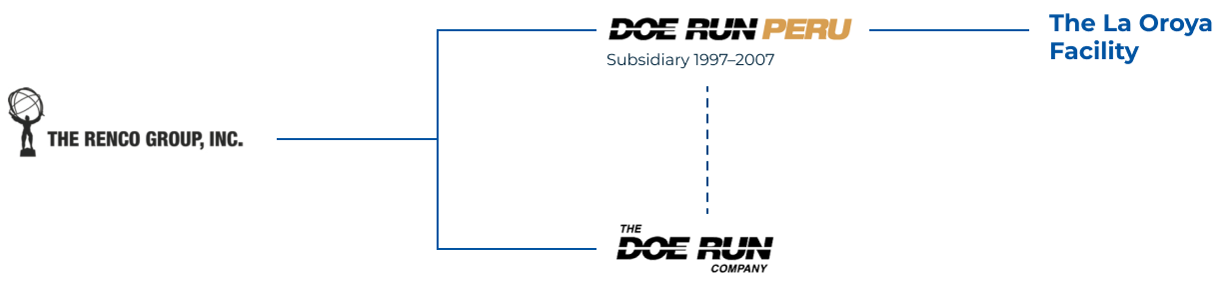
The Doe Run Resources Corporation is a Missouri mining and metals company that has existed for more than 160 years. It is a subsidiary of The Renco Group, Inc.
In 1997 Doe Run formed a Peruvian subsidiary, Doe Run Peru S.R. Ltd. Doe Run Peru bought a metallurgical complex in La Oroya, Peru, called the La Oroya Complex.
The La Oroya Complex was built in 1922 by a private company and then nationalized by the Velasco Peruvian government in 1974. It had been operated by a combination of private entities and the Peruvian government for 75 years before the Doe Run Peru purchase in 1997.
During those 75 years that La Oroya was in other hands, the facility was operated with little-to-no environmental controls and, as a result, the area around La Oroya was badly polluted at the time of the Doe Run Peru acquisition.
The terms of the acquisition included an agreement that Doe Run Peru would substantially modernize the complex and reduce emissions. Doe Run Peru agreed to a detailed series of projects, which the Peruvian government said would cost approximately $110 million over a period of years. This agreement was set forth in a document called a “PAMA”, a Spanish acronym for Programa de Adecuación y Manejo Ambiental, or Environmental Adaptation and Management Program. This estimate woefully underestimated the cost of the projects and, ultimately, Doe Run Peru spent over $300 million on modernization projects and reduced emissions in every category.
In addition to the facility modernization, Doe Run Peru built schools, roads, health clinics, brought running water to the community, launched school lunch and hygiene programs, installed hand-washing stations, conducted the first-ever health assessments of the community, and developed many other social and community programs.
The Peruvian government retained responsibility to remediate the soil in and around La Oroya and agreed to indemnify Doe Run and its affiliates for any liabilities incurred as a result of the prior operations and during the period in which Doe Run Peru was completing its obligations under the PAMA to modernize the complex.
Starting in 2007, two competing groups of plaintiffs’ attorneys have sued Doe Run, its parent company Renco, and multiple former executives. The U.S. attorneys travelled to Peru to solicit clients on whose behalf to bring these claims. To aid their recruitment efforts and give themselves legitimacy in the eyes of a deeply religious community, they recruited a nun and a priest to be the titular heads of the legal effort.
There are now more than 2,800 Peruvian citizens who claim to have been injured by emissions from the metallurgical complex located in Peru. The Peruvian entity, Doe Run Peru, that actually owned and operated the La Oroya complex, was not sued.
Doe Run Peru faced no such legal actions in Peru and, instead, enjoyed substantial support from the community and the thousands of people it employed.
In 2007 Doe Run Peru became a separate subsidiary of The Renco Group. In large part due to the global financial crisis of 2009, Doe Run Peru was forced into bankruptcy and closed in 2013.
In 2007, and again in April 2017, the government of Peru sent protest letters to the U.S. State Department indicating that this lawsuit should not be tried in U.S. courts because it would be an infringement on the sovereignty of Peru and in violation of the U.S.- Peru Trade Protection Agreement (TPA).
The US-Peru TPA expressly states that the United States will not “undertake environmental law enforcement activities in [Peru].” Having a U.S. court determine appropriate emissions standards for a smelter in Peru and impose sanctions – either through punitive or compensatory damages – is prohibited by the letter and the spirit of the TPA.
Bottom line – this lawsuit targets a U.S. company instead of the Peruvian company that owned and operated the Peruvian metallurgical complex; further, it’s a direct violation, broadly, of international trade agreements and, more specifically, the purchase agreement between Doe Run Peru and the Peruvian government. Finally, that the suit targets the parent companies of the company responsible for the PAMA, rather than the original owners of 75 years where the conditions in question materialized, raises significant ethical concerns.